
Play audiometry, visual reinforcement audiometry, child hearing test
Paediatric Hearing Assessment
Age appropriate testing for babies and children, using play, toys and visual rewards to obtain reliable thresholds long before a child can describe what they hear.
What this assessment is
A child does not need to speak or read to have their hearing measured accurately. What changes is the method, not the science. At Mombasa Hearing Centre we choose the technique that matches the child's developmental age, from objective testing in newborns to conditioned play audiometry in toddlers and pre schoolers. Early identification matters enormously: the first three years of life are when the auditory pathways and spoken language are built, and a hearing loss picked up at eight months has a very different outcome from the same loss found at four years.
Why it matters
- Permanent childhood hearing loss affects roughly one to two babies in every thousand, and many more acquire temporary loss from middle ear fluid.
- Untreated loss in early childhood delays speech, reading and school performance, and is frequently mistaken for inattention or stubbornness.
- Glue ear is common in coastal Kenya and is often silent. Tympanometry finds it in minutes.
- Once identified, most childhood hearing problems can be treated medically or managed with amplification and structured support.
At the centre
How it looks in practice
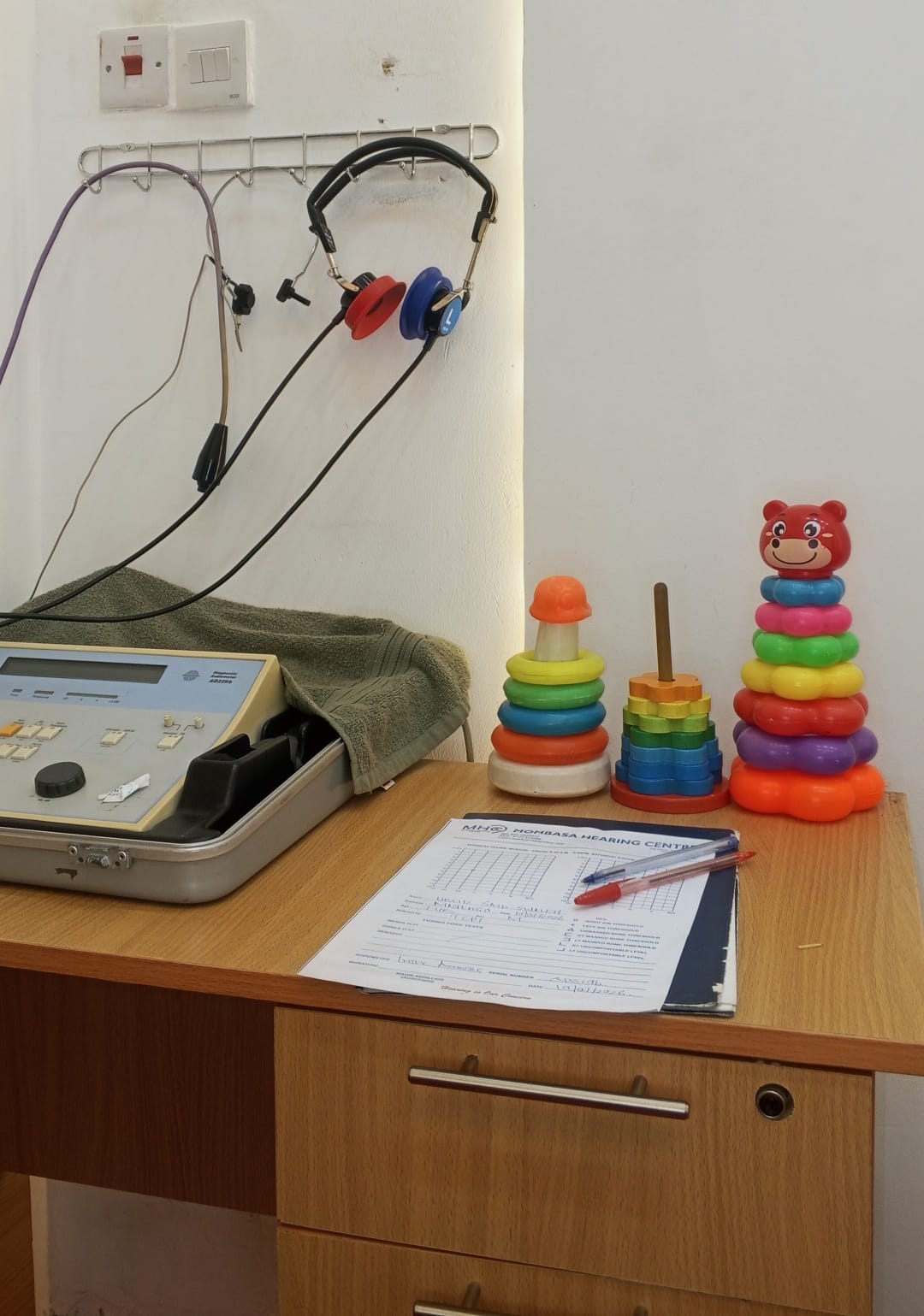
Photographs taken at Mombasa Hearing Centre during real clinical sessions.
Step by step
How the assessment is performed
Each stage follows established audiological protocol, and you are told what is happening before it happens.
- 1
Parent interview and developmental history
We ask about pregnancy and birth, jaundice, neonatal admission, meningitis, ear infections, family history of deafness, and how the child responds to sound and speech at home. Parents notice more than they realise, and that history shapes the test plan.
- 2
Otoscopy and tympanometry
Ears are examined and middle ear function screened, because fluid behind the eardrum is the single most common cause of childhood hearing difficulty and must be identified before anything else is interpreted.
- 3
Visual reinforcement audiometry, six months to two and a half years
The infant sits on a parent's lap. When a sound is presented, the child turns towards it and is rewarded with a lit or animated toy. The turn becomes a conditioned response, and thresholds are built up frequency by frequency.
- 4
Conditioned play audiometry, two and a half to five years
The child is taught a simple game: hold the ring or block to the ear, listen, and drop it in the bucket or onto the stack the instant the beep arrives. Once the conditioning is solid, the audiologist lowers the level to find true thresholds. Two testers are often used, one to run the audiometer and one to keep the game moving.
- 5
Objective testing when required
For newborns, children who cannot condition, or where results are inconsistent, we move to otoacoustic emissions and brainstem evoked response audiometry, which need no active cooperation at all.
- 6
Report, counselling and referral
Results are explained the same day with a written report for the paediatrician, ENT surgeon or school. Where amplification is indicated we discuss paediatric fitting, real ear measurement and the support the family will need.
How to prepare
- Book a time when your child is normally alert and fed, usually mid morning.
- Bring a favourite toy or comfort item, and a second adult if you have other children with you.
- Bring the child health booklet, immunisation record and any hospital letters.
- Do not tell the child it is a hospital test. Describing it as a listening game removes most of the anxiety.
Understanding your results
- Normal for age
- Thresholds within the normal range with healthy middle ear pressure. We advise on speech milestones and when to return.
- Temporary conductive loss
- Usually glue ear or infection. We refer to ENT for medical management and re test after treatment, since most of these losses resolve.
- Permanent sensorineural loss
- Confirmed with objective testing, then managed with early amplification, family counselling, speech therapy referral and close monitoring as the child grows.
FAQ
Common questions
My baby is only a few weeks old. Can you still test?
Yes. Newborns are tested with otoacoustic emissions and brainstem evoked response audiometry while they sleep naturally after a feed.
What if my child refuses to cooperate?
That is normal and it is not a wasted visit. We gather what we can, then either bring the child back or switch to objective testing that does not require cooperation.
Can I stay in the room?
We prefer it. A calm parent nearby makes for a calm child and a better result.
Explore
Other tests we perform
Pure Tone Audiometry
The reference test for hearing. It maps the quietest sounds you can detect across the speech frequencies and shows whether a loss sits in the outer, middle or inner ear.
Tympanometry and Impedance Audiometry
A rapid objective measure of how the eardrum and middle ear move, detecting fluid, negative pressure, perforation and ossicular problems within seconds per ear.
Brainstem Evoked Response Audiometry
An objective test of the hearing nerve and brainstem pathway. Small surface electrodes record the brain's automatic response to sound while the patient rests or sleeps quietly.