
PTA, air and bone conduction testing
Pure Tone Audiometry
The reference test for hearing. It maps the quietest sounds you can detect across the speech frequencies and shows whether a loss sits in the outer, middle or inner ear.
What this assessment is
Pure tone audiometry is the foundation of every hearing file we open at Mombasa Hearing Centre. Using a calibrated diagnostic audiometer, our audiologist presents pure tones at set frequencies, usually 250 Hz through 8000 Hz, and gradually reduces the level until you can only just hear each tone. The softest level you respond to reliably becomes your threshold, and those thresholds are plotted on an audiogram: one symbol set for the right ear, another for the left.
Why it matters
- It quantifies hearing loss in decibels rather than guesswork, so progress can be tracked year after year.
- Comparing air conduction with bone conduction separates conductive problems, such as fluid or wax, from sensorineural loss in the cochlea.
- Hearing aid prescriptions are calculated directly from these thresholds. Without an accurate audiogram, a fitting is only an estimate.
- Employers, schools, aviation and maritime medical boards along the coast accept a signed MHC audiogram as formal documentation.
At the centre
How it looks in practice
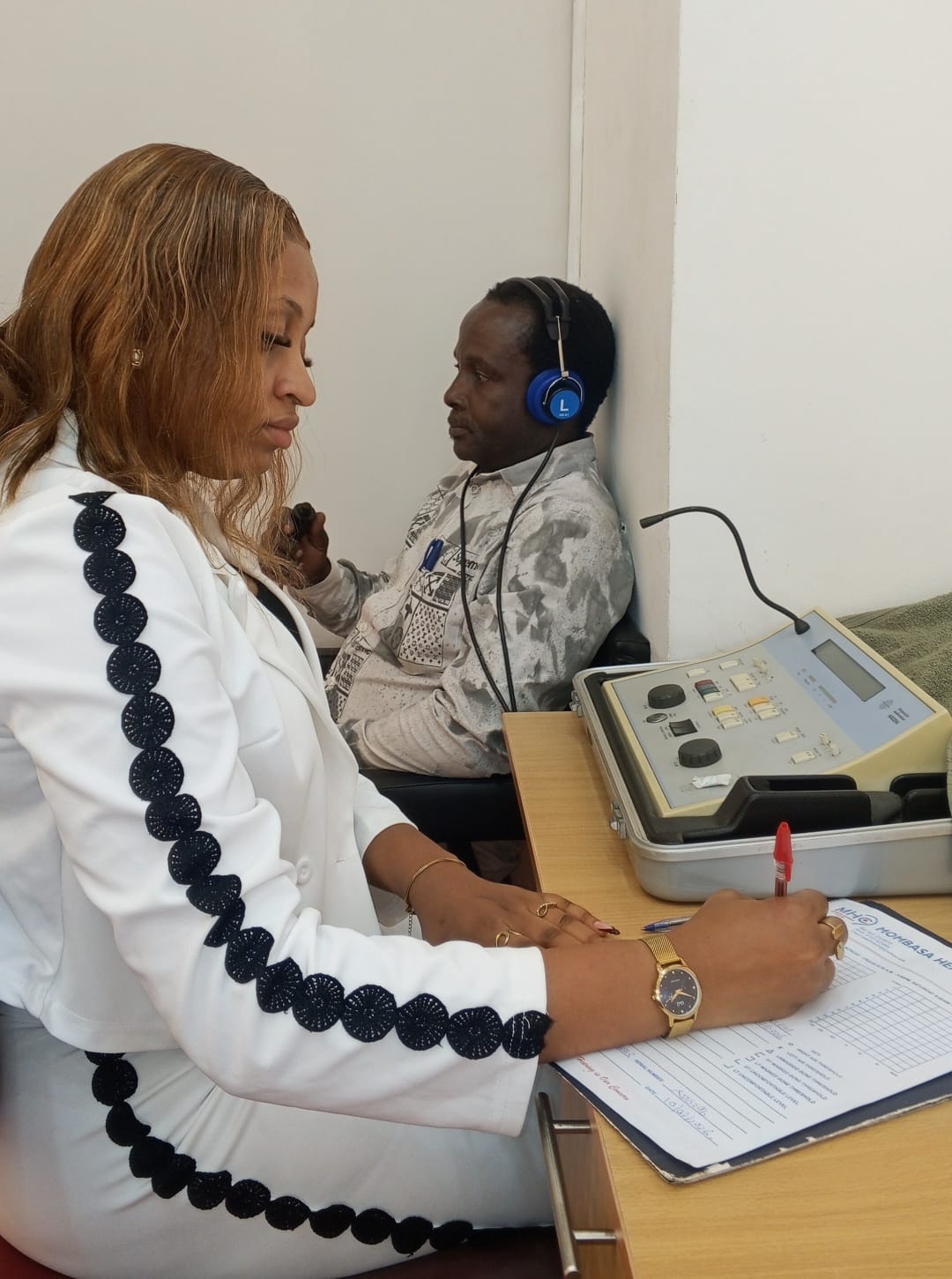
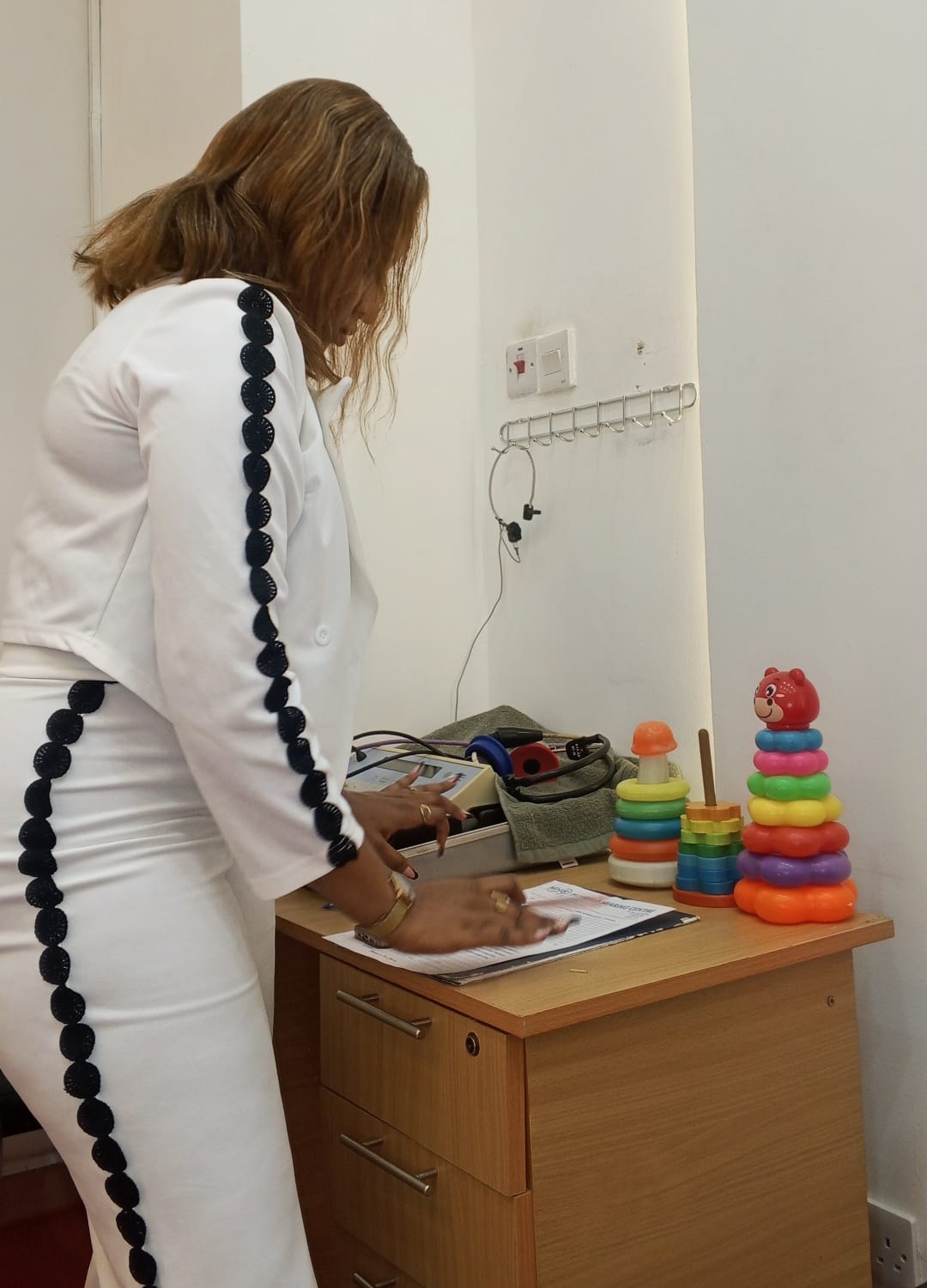
Photographs taken at Mombasa Hearing Centre during real clinical sessions.
Step by step
How the assessment is performed
Each stage follows established audiological protocol, and you are told what is happening before it happens.
- 1
History and otoscopy
We start with a short conversation about how the difficulty began, noise exposure, ear infections, medication and family history. The audiologist then examines both ear canals and eardrums with an otoscope. If wax is blocking the canal it is cleared first, because a blocked canal will distort every result that follows.
- 2
Air conduction thresholds
Headphones or insert earphones are placed and you are asked to press a response button, raise a hand or say yes whenever you hear a tone, however faint. Each frequency is tested using a descending and ascending sequence until a reliable threshold is confirmed at least twice.
- 3
Bone conduction thresholds
A small bone vibrator is rested on the mastoid bone behind the ear. Because it bypasses the outer and middle ear and stimulates the cochlea directly, any gap between the air and bone results tells us the loss has a conductive component that may respond to medical treatment.
- 4
Masking where needed
When one ear hears much better than the other, sound can cross the skull and be picked up by the good ear. A controlled narrow band noise is delivered to the better ear so the test ear is measured honestly. This is a skilled step and it is one of the reasons an audiologist, not an app, should record your thresholds.
- 5
Speech testing
We add speech reception thresholds and word recognition scores so we know not only what you can hear but how much of it you can understand. Two people with the same audiogram can have very different clarity, and this measurement guides realistic expectations from hearing aids.
- 6
Explaining the audiogram
Before you leave, the audiologist walks you through the chart, marks where speech sounds fall on it and explains the degree and configuration of any loss in plain language, in English or Kiswahili.
How to prepare
- Avoid loud noise, including loud music and machinery, for at least 16 hours before the appointment so temporary threshold shift does not exaggerate the result.
- Do not attempt to clean the ears with cotton buds. Wax pushed deeper makes the test harder.
- Bring any previous audiograms, ENT letters or medication lists.
- If you have an active ear infection or discharge, call us first. It may be better to treat that before testing.
Understanding your results
- Normal hearing
- Thresholds of 25 dB HL or better across the frequency range. If you still struggle in noise despite a normal audiogram, we investigate further with speech in noise testing.
- Mild to moderate loss
- 26 to 55 dB HL. Conversation in quiet is usually manageable, but group settings, mosque or church halls, and television become tiring. Most people at this level benefit clearly from amplification.
- Moderately severe to severe loss
- 56 to 90 dB HL. Speech is missed without help. Well fitted, correctly verified hearing aids make the difference between isolation and participation.
- Profound loss
- Above 90 dB HL. We discuss high power amplification and, where appropriate, refer for cochlear implant assessment with a clear written report.
FAQ
Common questions
Will the test hurt?
No. Pure tone audiometry is completely painless. The loudest tones used are brief and you are always warned before they are presented.
Can I fail a hearing test?
There is no pass or fail. The audiogram simply describes how you hear today so we can plan the right next step.
How often should it be repeated?
Every two years for adults with normal hearing, annually if you wear hearing aids or work in noise, and sooner if anything changes suddenly.
Explore
Other tests we perform
Paediatric Hearing Assessment
Age appropriate testing for babies and children, using play, toys and visual rewards to obtain reliable thresholds long before a child can describe what they hear.
Tympanometry and Impedance Audiometry
A rapid objective measure of how the eardrum and middle ear move, detecting fluid, negative pressure, perforation and ossicular problems within seconds per ear.
Brainstem Evoked Response Audiometry
An objective test of the hearing nerve and brainstem pathway. Small surface electrodes record the brain's automatic response to sound while the patient rests or sleeps quietly.